


Qui sommes-nous ? origin
Santé Diabète is a non-governmental organisation founded in 2001 to address the lack of access to care for people living with diabetes in Africa and help make this health emergency an international priority.
D’abord présente au Mali, Santé Diabète a ensuite développé ses actions au Burkina Faso, au Sénégal (jusqu’en 2018), en Union des Comores, au Cap Vert ainsi qu’en France (siège de l’association), avec des équipes permanentes dans chaque pays.
Our mission
Strengthening and structuring health systems for better diabetes prevention and care
With a team of 45 people and more than 200 local and international partners, Santé Diabète works on the ground every day to save lives through better diabetes prevention and care, improving the quality of life of people living with this chronic condition.
Our NGO takes a comprehensive approach encompassing all the areas needed to deliver quality diabetes prevention and care.
THIS INNOVATIVE APPROACH IS PUT INTO PRACTICE
THROUGH SIX COMPONENTS :
1. Primary prevention
to reduce the human and economic burden of the growing epidemic
2. Decentralisation of care
to ensure that quality care is geographically accessible to communities
3. Secondary and tertiary prevention and therapeutic patient education
to reduce the burden of diabetes-related complications
4. Reducing the cost of care
to enable people to access diabetes care
5. An integrated approach
to ensure the active participation of patients and their families by supporting patient associations, self-management and advocacy mechanisms
6. Research
to develop innovative approaches through research
This approach is implemented on the ground with all institutional partners: national and local authorities, healthcare professionals, civil society, communities and people living with diabetes.
By providing technical assistance to support government policies on diabetes prevention and care, the NGO ensures that its interventions deliver long-term solutions.
Santé Diabète a ainsi développé depuis 2001 une expertise très pointue du diabète en Afrique et dans les pays à faible et moyen revenu, et plus largement de la santé et du développement. Cette expertise lui permet d’appuyer de nombreux gouvernements dans le développement de leur politique de lutte contre les maladies non transmissibles et plus spécifiquement contre le diabète.
Plus largement, elle permet à l’ONG de développer d'autres expertises autour de ces problématiques pour des gouvernements, des organisations internationales et les Nations Unies.
Les résultats de terrain et le pôle d’experts impliqués ont progressivement fait de l’ONG Santé Diabète une structure de référence au niveau global pour de nombreuses organisations internationales ( Organisation Mondiale de la Santé, International Diabetes Federation,…), sociétés savantes (Société Francophone du Diabète…), centres de recherche (Transnut Université de Montréal…) et universités (Université de Grenoble, Université de Montréal, Université de Genève, Université de Harvard,…).
Santé Diabète since 2001
Strong values and a humanist approach
Nos valeurs se retrouvent avant tout au quotidien, sur le terrain, avec l'appui de nos partenaires. Nous préférons qualifier notre approche d'humaniste que d'humanitaire.
We have chosen measured growth, drawing on the strength of our networks to remain as close as possible to needs on the ground. This enables us to maintain effective oversight of our activities and ensure their relevance, quality and effectiveness.
Santé Diabète also draws its legitimacy and strength from its roots in local initiatives and processes. Through our interventions, we ensure that we never replace local actors and always seek to build the capacities of local partners and support them towards autonomy.
Our ethical principles
As an NGO, Santé Diabète upholds the fundamental principles that should guide humanitarian action: humanity, neutrality, impartiality and independence. We also undertake to uphold professional ethical principles and maintain complete independence from all authorities and all political, economic or religious forces.
Our work is also guided by the principles of care, with therapeutic patient education and psychosocial support considered just as important as clinical care.

Our gender strategy

La stratégie genre de Santé Diabète aims to give greater consideration to gender issues, both within Santé Diabète as an organisation and in its field activities. It is implemented by creating a gender-responsive environment and integrating these issues more fully into our programmes and the way we structure our response.
Our gender strategy draws on key guidance, including WHO and EU guidelines, on gender and health; gender issues in humanitarian settings, particularly violence; gender and work; and, of course, gender and diabetes. It considers the different gender-related socioeconomic factors that affect diabetes prevention and care. Certain comorbidities of diabetes, such as HIV/AIDS and tuberculosis, are also taken into account.
Ce document stratégique effectue également un rappel de la prise en compte du genre dans les documents officiels de nos différents pays d’intervention, et propose une bibliographie de ce qui nous semble particulièrement pertinent dans ce champ et dans l’élaboration de la stratégie de notre organisation.
It is intended for our teams, partners and beneficiaries, and for anyone wishing to better understand Santé Diabète’s approach to gender and the implementation of this strategy internally and in our programmes.
Our history
25 years of action
2001 - Foundation of Santé Diabète
- Santé Diabète was founded in 2001 by a group of specialists in diabetes, health and development to improve diabetes prevention and care in Africa.
2003 - First activities in Mali
- Stéphane Besançon, the NGO’s current Chief Executive Officer, is one of the founding members of the organisation. It was originally named Santé Diabète Mali after the country where its first field activities began in 2003.
2001/2011 - Expertise and a network of partners
- Between the NGO’s establishment in 2001 and the 2011 High-level Meeting on Noncommunicable Diseases (NCDs) during the United Nations General Assembly, the international context evolved towards greater recognition of NCDs.
- In this context, the NGO’s expertise and network of partners made it an essential international partner in interventions to improve diabetes prevention and care in Africa.
From 2010 - Strengthening activities in Mali and developing the first projects abroad
- Santé Diabète Mali undertook substantial work to strengthen its activities in Mali while preparing to develop projects in other countries. This expansion was requested by countries such as Burkina Faso, which wished to benefit from the methodologies developed over ten years in Mali, as well as the NGO’s legitimacy and partner network. It also responded to the need to strengthen global advocacy at a time when the international community was not yet giving sufficient attention to this health emergency.
2011 Santé Diabète Mali becomes Santé Diabète and broadens its mandate
This change of identity marked the beginning of a broader mandate, both geographically and in terms of its missions. It is based on four strategic priorities :
• Develop interventions in new countries beyond Mali (Burkina Faso, Union of the Comoros, Benin, Guinea, etc.).
• Provide specialised expertise in diabetes and, more broadly, in health and development, drawing on a network of internationally recognised experts.
• Make the skills acquired in West Africa available to French organisations working with migrants from sub-Saharan Africa.
• Strengthen advocacy among communities and authorities in countries of the Global North to improve understanding of diabetes and the challenges it poses in low- and middle-income countries.
From 2011 - New activities in France
- Launch of a programme on education for citizenship and international solidarity in France.
2012- Opening of a country office in Burkina Faso
- Création d’une délégation Santé Diabète au Burkina Faso
2013 - Opening of a country office in Senegal
- Establishment of a Santé Diabète country office in Senegal, which operated for five years before closing in 2018.
2016 - Opening of a country office in the Union of the Comoros
- Establishment of a country office in the Union of the Comoros and launch of a programme to address diabetes across the archipelago.
- An “AFD diabetes prevention expertise” mission in French Polynesia.
2017 - A new stage in the development of our programmes
- Launch of the first three-year multi-country programme involving Mali, Burkina Faso and the Union of the Comoros, to strengthen diabetes prevention and care in all three countries, co-financed by the French Development Agency.
- Lancement au Mali et au Burkina Faso d’un premier projet innovant visant à mieux intégrer la prévention et la prise en charge du diabète, du VIH et de la tuberculose, financé par L’Initiative / Expertise France
2018 - Participation in the third United Nations High-level Meeting
- Santé Diabète fait partie des structures de la société civile sélectionnées pour participer au 3ème Sommet de Haut Niveau des Nations Unies consacré aux maladies non transmissibles (MNT) durant l'Assemblée Générale des Nations Unies à New York
2019 - Organisation of the first inter-country scientific meetings
- Première journée scientifique inter-pays (Mali, Burkina Faso, Union des Comores et France) réalisée à Bamako (Mali) pour partager et capitaliser les activités mises en œuvre et les résultats obtenus dans les différents pays d’intervention
- Organisation d’une journée à l’Assemblée nationale à Paris, en France, sur les maladies non transmissibles au Nord et au Sud
2020 - Implementation of a COVID-19 response plan
- Launch of a second three-year multi-country programme involving Mali, Burkina Faso and the Union of the Comoros, to strengthen diabetes prevention and care in all three countries, primarily co-financed by the French Development Agency, the World Diabetes Foundation, the Helmsley Charitable Trust and the City of Grenoble.
- Déploiement d’un plan de réponse Covid-19 Diabète au Mali et au Burkina Faso.
2021 - Adoption of a historic WHO resolution on diabetes
- Adoption d’une résolution historique sur le diabète par les États membres de l’OMS sous l’impulsion de Santé Diabète
- Oganisation à Grenoble (France) d’une réunion d’experts francophones sur le diabète
- Launch of a second project to strengthen the integration of diabetes, HIV and tuberculosis prevention and care, now extended to the Union of the Comoros alongside Mali and Burkina Faso.
2022 - Opening of Diabetes Prevention Houses
- Inauguration of the first Houses for the Prevention of Diabetes Risk Factors in Burkina Faso, Mali and the Union of the Comoros. They strengthen our prevention activities with partner civil society organisations.
2023 - Missions exploratoires à Djibouti, au Togo et au Cap Vert
- Lancement d’un 3ème programme multi pays de trois ans impliquant le Mali, le Burkina Faso et l’Union des Comores, afin de renforcer la prévention et la prise en charge du diabète dans les 3 pays (financé par différents bailleurs de fonds suivant les pays pour répondre aux contraintes géopolitiques)
- En parallèle, Santé Diabète mène des missions exploratoires dans 3 nouveaux pays : Djibouti, Togo et Cap vert.
- The second inter-country scientific meeting (Mali, Burkina Faso, Union of the Comoros and France) was held in Moroni, Union of the Comoros, to share and consolidate learning from activities and results across the countries of intervention.
2025 - Inauguration des Maisons de la Prévention dans les pays d’interventions
- Inauguration of new regional Diabetes Prevention Houses, bringing the number of operational houses in Mali, Burkina Faso and the Union of the Comoros to 13. These bring diabetes and risk-factor prevention and care closer to communities, particularly outside the capitals.
- Santé Diabète participated in the fourth High-level Meeting on NCDs and mental health during the United Nations General Assembly in New York.
2026 - Une nouvelle phase : consolider les acquis et ouvrir un nouveau pays
- Following three successive three-year programmes in Mali, Burkina Faso and the Union of the Comoros, launch of a new three-year phase to consolidate achievements, capture and share lessons learned, and strengthen national partners’ autonomy to ensure the sustainability of activities. This new stage is supported by the longstanding funding partners that have worked alongside Santé Diabète in these three countries for many years.
- En parallèle, lancement d’un premier programme de trois ans au Cap Vert, en partenariat avec le ministère de la santé, marquant une nouvelle étape dans le développement des interventions de Santé Diabète. Il vise à améliorer la prévention et la prise en charge du diabète au niveau primaire de la pyramide sanitaire.
- The third inter-country scientific meeting (Mali, Burkina Faso, Union of the Comoros and the NGO’s international partners) was held in Moroni, Union of the Comoros, to share and consolidate learning from activities and results across the countries of intervention.
Our organization
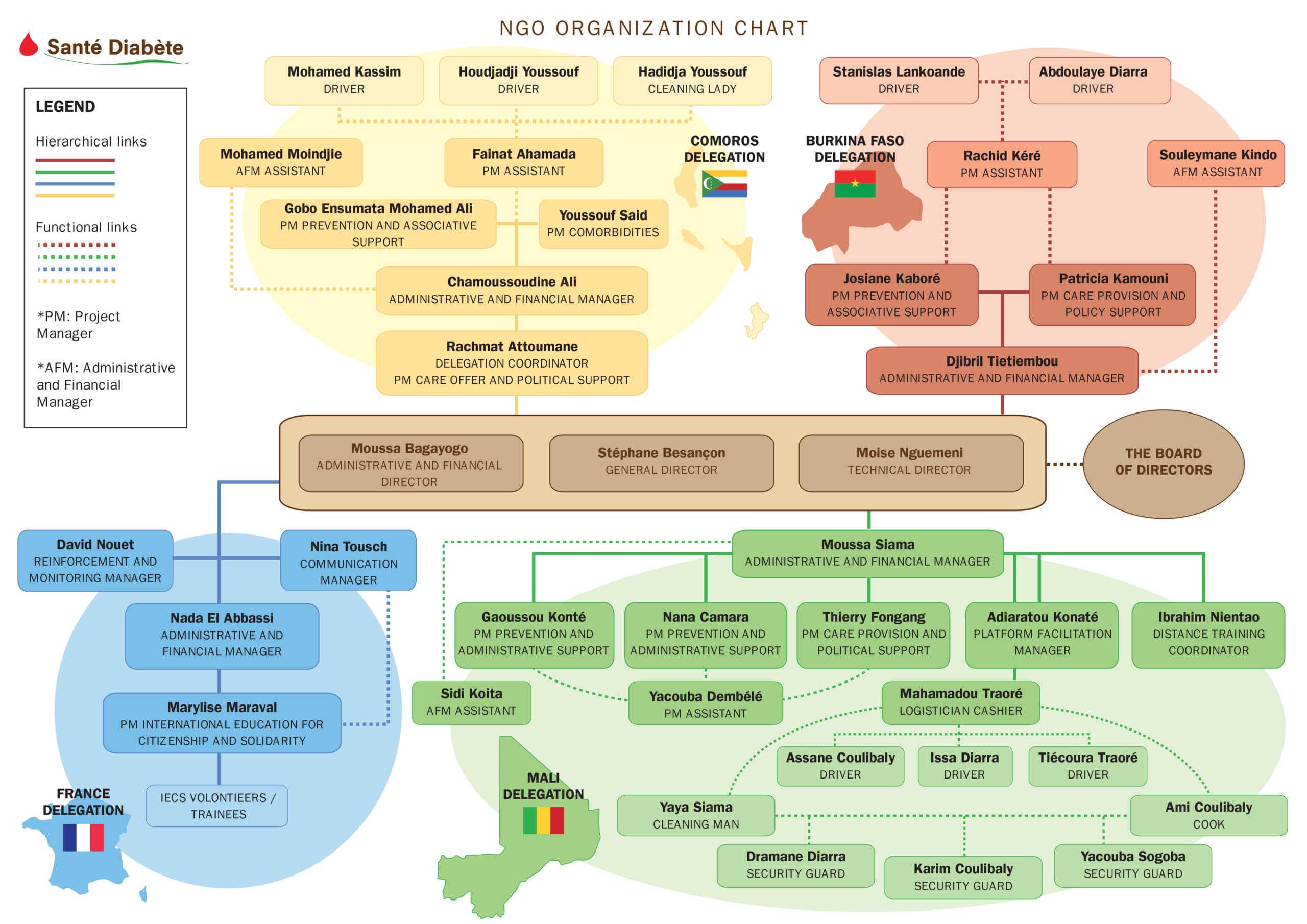
Organisation charts
➠
Our staff team

L’ONG Santé Diabète, c’est une équipe de 45 personnes organisée avec :
- An executive management team comprising a Chief Executive Officer, a Director of Administration and Finance, and a Technical Director.
- A support unit comprising a Communications Officer and an Officer responsible for strengthening the monitoring of prevention and care activities.
- A French headquarters with a Project Manager for Education for Citizenship and International Solidarity (ECSI) and an Administration and Finance Manager.
Three country offices in Mali, Burkina Faso and the Union of the Comoros, each comprising :
- D’un coordinateur(trice) de la délégation
- D’un responsable administratif et financier
- De chef de projet en charge des différents domaines d’intervention (offre de soins, prévention …)
Watch the video introductions to our teams here
The Board of Directors

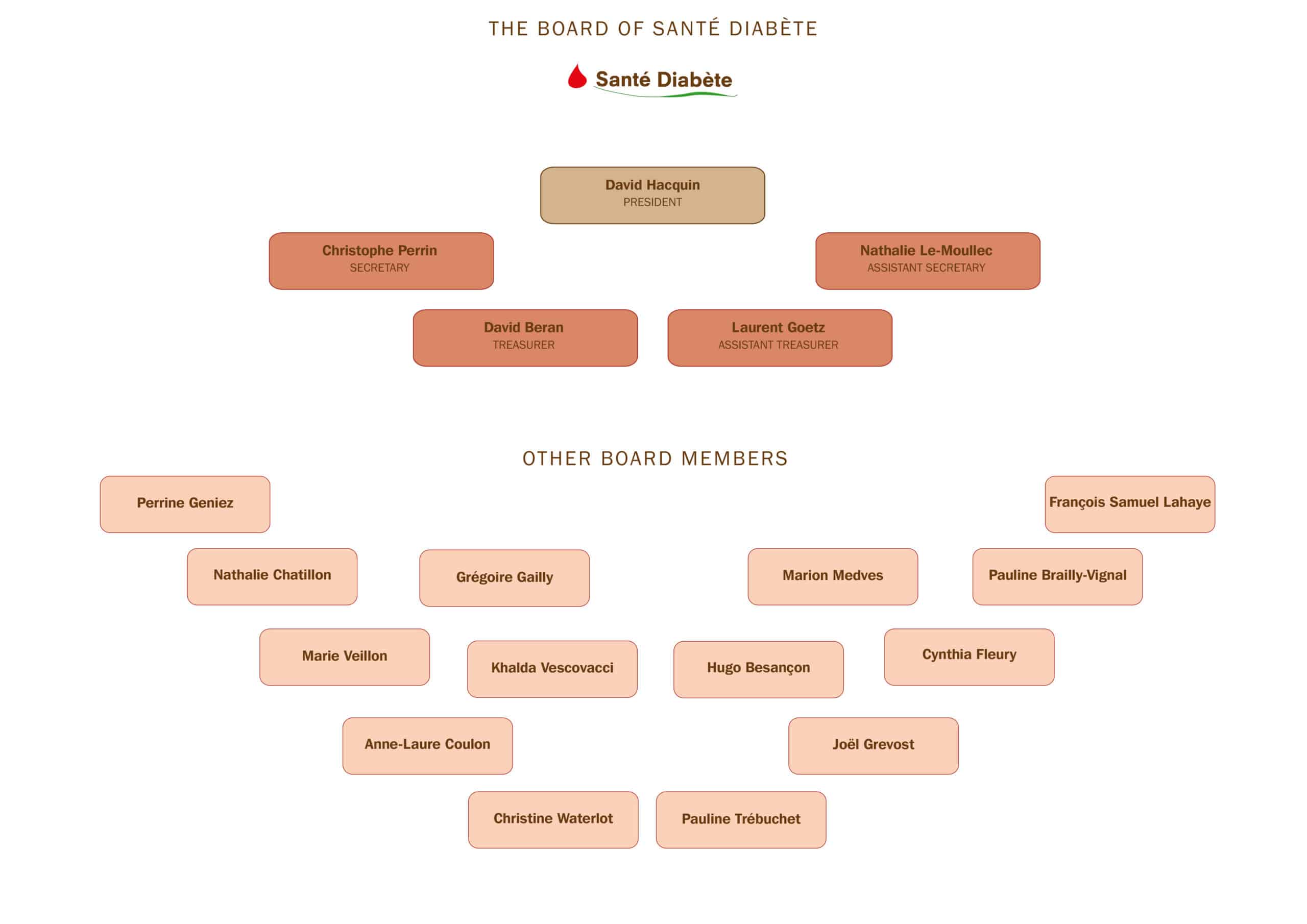
Following deliberation, the Board of Directors determines all of the association’s strategic directions. The Board meets with the Director at least every six months.
The Board has 18 members, including five Executive Committee members: the Chair, Secretary, Deputy Secretary, Treasurer and Deputy Treasurer.
- David Hacquin Chair
- Christophe Perrin Secretary
- David Beran Treasurer
- Laurent Goetz Deputy Treasurer
- Nathalie Le-Moullec Deputy Secretary
- Perrine Geniez Member
- Nathalie Chatillon Member
- Pauline Brailly-Vignal Technical focal point for patients
- François Samuel Lahaye Medical focal point
- Anne-Laure Coulon Medical focal point
- Christine Waterlot Medical focal point
- Cynthia Fleury Member
- Pauline Trébuchet Member
- Joël Grevost Member
- Grégoire Gailly Member
- Marion Medves Member
- Khalda Vescovacci Member
- Hugo Besançon Member
An international network of partners
Santé Diabète relies on a network of high-level partners who provide targeted expertise to guide its interventions and to carry out joint actions on the ground.
- International Diabetes Federation (IDF)
- World Health Organization (WHO)
- West African Health Organization (WAHO)
- World Diabetes Fondation (WDF)
- Société Francophone du Diabète (SFD)
- • Université de Montréal — Faculty of Medicine — Department of Nutrition, WHO Collaborating Centre on Nutrition Changes and Development
- Grenoble University Hospital
- Réunion University Hospital
- Paris University Hospital Center (La pitié salpêtrière)
- Necker–Enfants Malades University Hospital — Diabetology Department
- Geneva University Hospitals
- University of Geneva
- Harvard University
- University of Réunion — Education Sciences
- University of Sydney (Australia)
- French Diabetes Federation (FFD)
- Luxembourg Diabetes Association (ALD)
- Austrian Association of Diabetes Educators (VOD)
- International Insulin Foundation (IIF)
- Type 1 Diabetes SWEET initiative project
- Geneva Health Forum (GFH)
- Chair of Philosophy at the Hospital and Chair of Humanities and Health
- Observatoire de la transparence dans les politiques du médicament (OTMeds)
- Life for a Child (LFAC)
- Luxembourg Institute of Health (LIH)
- Health Action International (HAI)
- NCD Policy Lab
- T1International
- International Alliance for Diabetes Action (IADA)
- Direct Relief
- Science Po Grenoble
- Conservatoire National des Arts et Métiers (Cnam)
- Médecins Sans Frontières (MSF)
Our publications

A comprehensive 28-page report on Santé Diabète’s activities, including a breakdown of expenditure and resources.

Rapport MORONI

A concise 16-page presentation of Santé Diabète’s missions and programmes.
FINANCIAL TRANSPARENCY
Strict external and internal financial controls enable Santé Diabète to account at all times for the proper use of the funds entrusted to it: annual external audits by accredited international audit firms, certification of the association’s financial statements by a statutory auditor, and external audits by our partners.
98.5% of our funds are used directly in the field
98,5% Programme activities
1,5% operating costs
Our supporters

FRENCH DEVELOPMENT AGENCY (AFD)

World Diabetes Foundation (WDF)

The Helmsley Charitable Trust

Swiss Development Cooperation

Ministry of Solidarity and Health (France)

Ministry for Europe and Foreign Affairs (France)

City of Grenoble (France)

Acciss

Maison du Diabète (Luxembourg)

Life For A Child (LFAC)

NCD Policy Lab
Find out more
Santé Diabète in action
Discover Santé Diabète’s programmes and activities on the ground
